

Export Diversification Strategy Pays Off

Story by Erin Worrel, U.S. Soybean Export Council Communications Manager.
The U.S. Soybean Export Council has increased its emphasis on global market diversification as the competitive focus for U.S. Soy exports. That was fully displayed during Soy Connext 2026.
USSEC’s annual global conference gathers U.S. Soy customers, exporters, farmers, supply chain members and industry experts. Soy Connext 2026 welcomed over 800 attendees from more than 65 countries to Chicago, August 4 to 7, thanks in part to Kansas Soybean Commission’s sponsorship.
U.S. Soy remains the top agricultural export from the U.S., despite declines this year due in part to trade tensions with China. Soy exports are projected to grow in the next marketing year, October 2026 to September 2027, recovering much of those losses.
Two main factors drive the projected increase in exports: increasing soy demand across more markets and a projected return to more normal trade relations with China. Both of those factors were evident at Soy Connext.
- More than 30 customers from China attended, signaling U.S. Soy’s value to the country.
- The European Union has increased U.S. soybean meal imports nearly 500,000 metric tons compared to last year, and more than 50 customers from EU-27 nations attended.
- The Soy Connext delegation from Indonesia represented a market where imports of whole U.S. soybeans track about 500,000 metric tons ahead of last year.
- More than a dozen customers came from Colombia, the third-largest importer of U.S. soybean meal.
- Egyptian participants represent a market that has rapidly expanded U.S. whole soybean imports, increasing purchases 27% over the past 5 years and nearly 68% over the past 10 years.
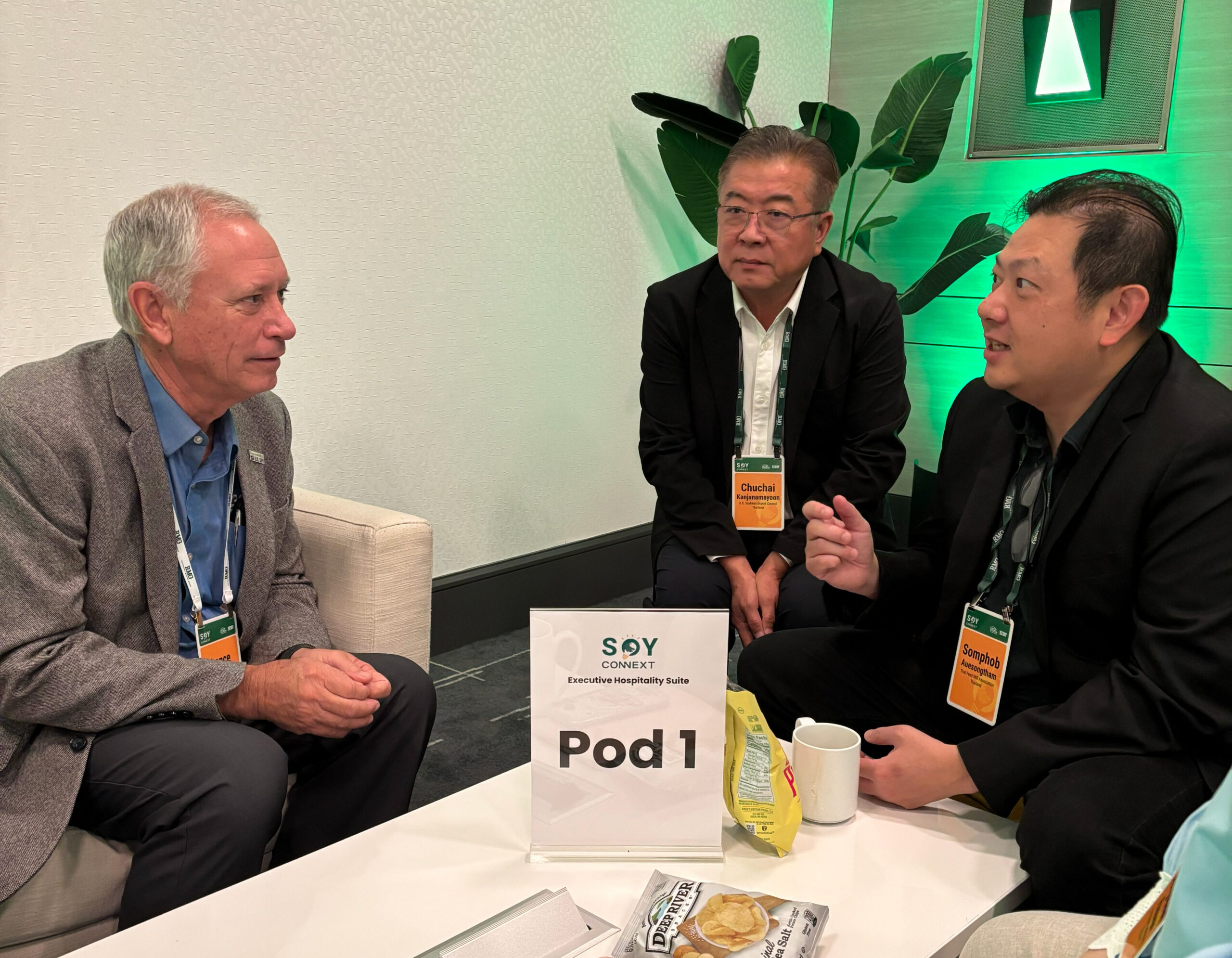
“I have visited customers around the world, in markets like China, India, Colombia, Algerian and more, and I’ve hosted trade teams on our farm for 25 years,” says Lance Rezac, an Onaga farmer and KSC commissioner who attended the event. “I know that some soybeans grown in Kansas go to Mexico.”
USSEC analysis shows that U.S. Soy exports to all markets besides China have increased approximately 6.6% over this time last year (through mid-August 2026), on top of a record set the year before. That’s evidence that more countries are recognizing the U.S. Soy advantages in value, quality, reliability and sustainability.
“We have found that U.S. Soy offers better digestibility, especially for our chickens,” says Soy Connext attendee Amir Boussouf, general manager of Milavita, an integrated poultry and dairy operation in Algeria with its own feed mill. “We see digestibility problems with soybean meal from soybeans of other origins, while we have zero problems with U.S. Soy. So, we buy soybean meal from crushers when we know they are using U.S. soybeans.”
The Soy Connext agenda reinforced those advantages with insights from industry experts, panel discussions and countless conversations across the supply chain. The Trade Team Invitational alone connected 134 key buyers and 42 exporter companies through one-on-one meetings to strengthen trade relationships and conduct business. Many attendees also participated in trade team tours before and after the conference. Following Soy Connext, a trade team of customers from Sri Lanka and Nepal visited KSC Commissioner Bob Haselwood’s farm near Berryton, Kansas, as well as Kansas-based exporters The Andersons in Overland Park and DG Global in Topeka.
“I’m always impressed by the questions customers ask,” Rezac says. “They want our knowledge. We are the gold standard for agriculture. Customers from Egypt reinforced that when they taught me about aflatoxin in soybean meal and how much better the quality of our soybean meal is compared to other origins.”
Soy Connext emphasized the ability of U.S. Soy, including Kansas farmers, to meet growing global demand for protein and oil. Global soybean stocks are projected to tighten even as U.S. and global soybean production grows. Domestic crush is also expanding, and Kansas has capacity to crush 71% of its 2025 soybean crop of 196.4 million bushels. Yet the 2026 U.S. soybean crop is forecast at a record level of 4.5 billion bushels, supported in part by Kansas increasing soybean planting about 800,000 acres. Plus, U.S. soybean meal exports totaled a record 16.3 million metric tons (MMT) in MY 2024/25. Through two-thirds of MY 2025/26, soybean meal exports track roughly 1.4 MMT ahead of that pace.
“China doesn’t want to rely only on us, and we don’t want to rely only on them, but we continue to value one another as trading partners,” Rezac adds. “Market diversification is a win-win for us, for China and for customers in other countries.”
Kansas farmers will continue to benefit from USSEC’s export diversification strategy and efforts to demonstrate the value, reliability, quality and sustainability of U.S. Soy. As global markets experience these advantages, demand for Kansas soybeans will grow.